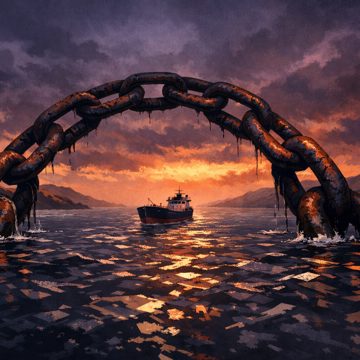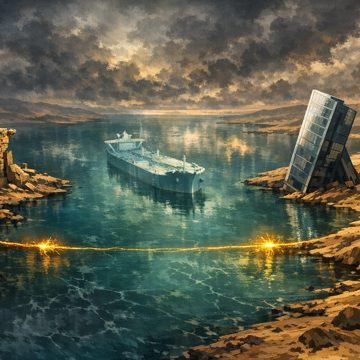
The Bahrain-facing edge of the Strait of Hormuz crisis is exposing how fragile global energy routes remain, while also reshaping the outlook for shipping, consumer brands, and AI infrastructure that depends on cheap power and stable logistics.
Strait of HormuzAI infrastructureoil shockbahraingulf securitytanker trafficenergy crisisconsumer brands

Bahrain sits on the front line of the Strait of Hormuz crisis not because it is the largest oil producer in the region, but because its economy, shipping lanes, and broader Gulf position are tied to a waterway that remains one of the world's most consequential chokepoints. When movement through the strait is disrupted, the effects do not stay offshore. They reach fuel prices, tanker traffic, industrial planning, and the cost structure behind everything from transport to cloud computing.
The sharpest warning is simple: modern energy systems are not built for a prolonged cutoff of Gulf exports. Even a partial closure can create a cascading shortage because tankers cannot instantly reroute, refineries cannot instantly switch feedstock, and storage is finite. The result is not just a higher oil price on a screen. It is a slow, physical bottleneck. Ships wait in place. Insurance costs rise. Loading schedules slip. Refiners draw down reserves. Importers scramble for alternative cargoes at higher prices. Bahrain, like its neighbors, is exposed to that chain reaction even if the immediate fighting or blockade is elsewhere.
That is why the crisis is being compared to a resource shock rather than a conventional regional flare-up. The concern is not only that crude becomes more expensive, but that the damage spreads across the broader economy. Gulf states can use reserves for a time, but reserves are not a permanent substitute for open sea lanes. If the disruption lasts, the impact moves from energy markets into manufacturing, shipping, aviation, food imports, and consumer prices. The developing world is especially vulnerable because it has less room to absorb a sudden jump in fuel and freight costs.
Bahrain's role in this picture is also political. The island kingdom has long depended on regional stability, external security guarantees, and the free flow of trade through nearby waters. That makes it a useful lens for understanding why the Strait of Hormuz matters far beyond the Gulf. A crisis there is not just about one country's exports. It is about the architecture of global commerce. A narrow channel only a few dozen kilometers wide carries an outsized share of the world's oil and a substantial amount of liquefied natural gas. When that channel is threatened, every actor downstream has to rethink assumptions about delivery times, inventory levels, and energy security.
The market reaction has been uneven. Some energy producers benefit quickly from tighter supply, but the broader system is less forgiving. Higher prices can help upstream firms while hurting refiners, airlines, trucking companies, and consumer-facing brands. That tension matters for the AI economy too. Data centers, chip fabs, and large-scale computing clusters are power-hungry. They depend on reliable electricity and on supply chains that move hardware, cooling systems, and replacement parts without interruption. If fuel and shipping costs rise for long enough, the ripple effects reach the cost of building and running AI infrastructure.
Consumer brands are another pressure point. Companies that rely on global sourcing, just-in-time logistics, and predictable freight rates can absorb only so much disruption before margins compress or prices rise. Packaging, plastics, fertilizers, and transport all become more expensive when oil and gas markets are stressed. That means the crisis in Bahrain-adjacent waters is not only a story about geopolitical leverage. It is also a story about how fragile the modern consumer economy remains when a single chokepoint is challenged.
There is also a historical dimension worth remembering. The Gulf has seen repeated cycles of tension, embargo, war, and reconstruction, yet the world kept assuming that maritime energy flows would remain mostly uninterrupted. That assumption now looks weaker. The lesson from past crises is that supply shocks do not resolve neatly. They linger in contracts, shipping insurance, strategic reserves, and investment decisions. Even when the immediate danger eases, confidence takes much longer to recover. Bahrain's proximity to the strait means it is part of that memory as well as the present danger.
The political stakes are high because the crisis invites outside powers to test red lines. China, the United States, and regional states all have an interest in keeping the passage open, but they do not always agree on how to do that. Diplomatic pressure, maritime patrols, sanctions, and military deterrence all have limits. If the route stays constrained, the world may see a longer period of elevated prices and strategic uncertainty rather than a quick return to normal. That would reshape not just energy policy but trade policy and industrial planning.
For Bahrain, the immediate question is resilience. For the rest of the world, the question is whether the shock exposes a deeper weakness in the system. The answer may be yes. A crisis in the Strait of Hormuz reveals how much of the global economy still depends on narrow, vulnerable transit points. It also shows how quickly that dependence can move from an abstract geopolitical concern to a concrete cost for households, companies, and the next generation of infrastructure, including the AI systems now being built on top of that same fragile world.