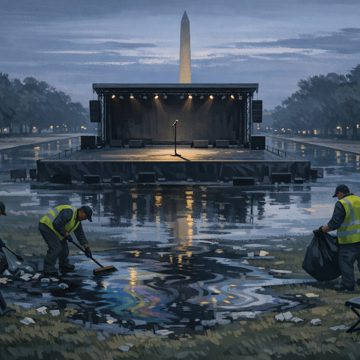
The Freedom 250 concert built around the 250th anniversary celebrations has been hit by a wave of artist withdrawals after performers said they believed it was a nonpartisan event. With the lineup collapsing, Trump is now expected to take center stage himself, turning vanilla ice into a symbol of the event's unraveling.
concertTrumpFreedom 250vanilla iceartist withdrawalsrally250th anniversary

Vanilla Ice has become the most recognizable name attached to the collapse of Trump's Freedom 250 concert plans, even as the event itself has changed shape so quickly that the original lineup now looks like a draft rather than a finished bill. What was meant to be a celebratory concert series tied to the United States' 250th anniversary has instead been marked by a string of withdrawals, confusion over how the event was presented, and growing criticism that it was never truly nonpartisan in the first place.
The original roster was built around a mix of pop, rock, country, and nostalgia acts, with names including Vanilla Ice, Young MC, Bret Michaels, Martina McBride, the Commodores, C+C Music Factory, Morris Day and the Time, Flo Rida, and others. But within a short time of the lineup being announced, many of those performers said they would not appear. Some said they had not agreed to participate at all. Others said they believed they were being booked for a patriotic, nonpartisan celebration and only later learned the event was tied closely to Trump's political operation.
That distinction matters because the concert was not being pitched as a routine campaign rally. It was framed as part of a larger national commemoration, with the 250th anniversary of the country as its backdrop. That framing gave the event a public, ceremonial tone that made the withdrawals more damaging. Artists who might have signed on for a broad celebration of American music and history were suddenly associated with a partisan spectacle. Once that perception set in, the lineup began to collapse.
Several performers made clear that the problem was not simply scheduling or logistics. The objection was the event's identity. Young MC said he had not been told about the political connections. Jodie Rocco described seeing her name in promotional material as a shock. Martina McBride said she had been presented with an opportunity to perform at a nonpartisan event, but that it had turned out to be misleading. Bret Michaels later said what had been described as a celebration of the country had become something much more divisive. That pattern suggests a broader failure in how the concert was sold, and why so many artists moved away from it once the political context became clear.
The result is a high-profile embarrassment for an administration that wanted the 250th anniversary to be part pageant, part political showcase, and part personal branding exercise. Critics have argued that Trump has repeatedly blurred the line between national events and his own image, and Freedom 250 has become a prime example. Instead of a broad, unifying celebration, the concert has come to look like another extension of his brand: loud, self-referential, and increasingly isolated from the kind of mainstream cultural support that would have made the event feel legitimate.
That perception has only deepened because Trump has reportedly decided to step in as the headline act himself. Rather than quietly rebuilding the lineup, he has signaled that the festival may be turned into a rally, with his own appearance replacing the missing musicians. He has even claimed he could draw larger audiences than Elvis in his prime. The move fits his long-running style of turning a setback into a stage, but in this case it also confirms what many critics suspected: the event was always more about him than about the anniversary it was supposed to honor.
The shift from concert to rally is also a practical admission that the original concept failed. A national celebration that loses most of its performers almost immediately is no longer functioning as a music festival. It becomes a political gathering with a thin cultural wrapper. That is why the withdrawals matter beyond the names involved. They show how difficult it has become to separate patriotic symbolism from partisan loyalty once Trump attaches his own brand to it.
The irony is that the lineup itself was built around artists who might have made sense for a broad, nostalgic celebration of American pop culture. Vanilla Ice, Young MC, the Commodores, C+C Music Factory, Morris Day and the Time - these are acts that could have fit a multigenerational public event. But once the event was perceived as politically loaded, the same names became liabilities. The artists were no longer being asked to perform at a national celebration. They were being asked to lend credibility to a political project.
That is the core reason the Freedom 250 concert has become such a mess. It was sold as one thing and understood as another. The mismatch between presentation and reality pushed performers away, and the collapse of the lineup made the event look disorganized at best and deceptive at worst. In that sense, the withdrawals are not just a list of cancellations. They are a referendum on how much political branding the country will tolerate when a national milestone is involved.
There is also a broader symbolic cost. The 250th anniversary was supposed to be an opportunity to reflect on the country's history and shared identity. Instead, it has been pulled into the same cycle of personality-driven spectacle that defines so much of modern politics. Even planned side events, from White House UFC fights to other highly stylized appearances, have reinforced the sense that the anniversary is being used as a stage for Trump rather than as a moment for the country.
That is why the image attached to the event is no longer a concert poster but a collapsing bill of performers, with Vanilla Ice standing in for the broader failure. The name is memorable, but it is also symbolic of how the whole project has been reduced to a joke: a supposed national celebration that cannot hold onto its artists, cannot settle on its purpose, and may end with Trump himself as the only headliner left.
If the event goes forward as a rally, it will not solve the underlying problem. It will simply confirm that the concert was never really the point. The withdrawals have already made that clear. Freedom 250 was supposed to showcase America. Instead, it has exposed the limits of turning a national milestone into a political brand exercise.