Faint 8647 markings found in the grass near the Washington Monument on the National Mall prompted a federal investigation after aerial photos showed the numbers near the World War II Memorial. Authorities are treating the case as vandalism while the meaning of the figures remains disputed.
national mallwashington monument8647washington d.c.vandalismu.s. park policeworld war ii memorialpolitical message

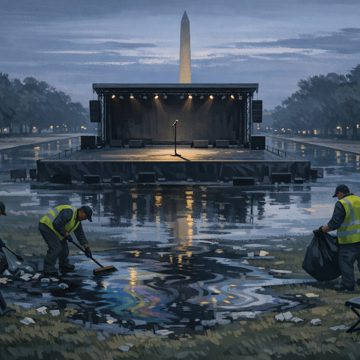
Federal authorities are investigating faint markings that appeared on the National Mall near the Washington Monument, where aerial photos showed what looked like the numbers 8647 traced into the grass close to the World War II Memorial.
The markings were first seen from the top of the Washington Monument, where a photographer captured images of the west lawn before federal officials arrived. In the photos, the number 8 is the most visible, while the 6, 4 and 7 are harder to make out. It was not immediately clear how the figures were made or who was responsible.
U.S. Park Police said they responded to a report of vandalism at about 11:30 a.m. and found the numbers marked in the grass. Officials said the cause of the discoloration had not yet been determined and that grass samples were collected for testing. The investigation is ongoing.
The Interior Department described the incident as vandalism on one of the nation's most prominent public spaces and said it would not be tolerated. The department also said any threat against the president is taken seriously and that those responsible would be held accountable if identified.
The appearance of 8647 has drawn attention because the numbers can carry political meaning. The term 86 is commonly used in American slang to mean throw out, remove, or get rid of something. In some settings it is a routine kitchen term, but in political contexts it has taken on a more charged meaning. The 47 is widely understood as a reference to President Trump, the 47th president.
That combination has made the markings hard to dismiss as ordinary graffiti. Supporters of the president see the phrase as a threat, while others argue it can be read as a political message or an act of protest. Authorities have not said whether the markings were intended as a threat, a slogan, or simply vandalism.
The case comes at a time when the phrase has already gained extra scrutiny after a separate incident involving the same numbers. That earlier episode led to federal charges and intensified attention on how a short numerical message can be interpreted very differently depending on context. The Washington Monument markings now place that same question in a more visible setting: one of the most recognizable lawns in the capital.
The location matters as much as the message. The west lawn of the Washington Monument sits at the center of a heavily visited national landscape, surrounded by memorials and watched closely by security officials. Any alteration there is quickly noticed, especially when it appears in a form that can be read as political speech.
The episode also highlights a recurring problem for public spaces in Washington: how to separate expression from vandalism. A message written on grass is easier to remove than paint on stone, but the symbolism can be harder to erase. On the National Mall, even a temporary mark can become a national story because of where it appears and what it seems to say.
For now, investigators have not identified a suspect or announced a conclusion about the markings' origin. They have not said whether the discoloration was created with a chemical, a physical tool, or some other method. The collected samples may help determine whether the grass was deliberately altered and how long the markings had been visible before they were discovered.
The public reaction has been shaped by both the wording and the setting. A simple number sequence in another place might have passed unnoticed. On the National Mall, beside the Washington Monument and within sight of the World War II Memorial, the same sequence immediately took on added weight.
That is why the 8647 markings have attracted so much attention. They sit at the intersection of public property, political symbolism, and federal security concerns. Whether they prove to be a threat, a protest, or a prank, the episode has already turned a patch of grass into a test of how authorities respond when a brief message lands in one of the country's most visible civic spaces.