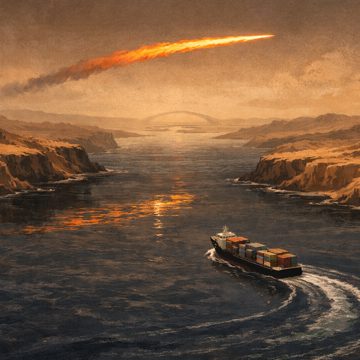
The Dark Eagle hypersonic missile is now central to a widening security picture: U.S. planners are weighing its first possible combat use against Iran, Russia is signaling a short ceasefire in Ukraine, and fresh claims about oil shocks and UAP declassification are feeding a broader sense of strategic instability.
irannational securityTrumpoil pricesdark eagle hypersonic missileUkraine warPutin ceasefireUAP declassificationhypersonic weapons

The Dark Eagle hypersonic missile has moved from a long-term Pentagon program into a live symbol of a fast-changing security landscape. Reports that U.S. planners are considering the weapon for possible deployment against Iran have raised the stakes around an already tense Middle East standoff, while developments in Ukraine and renewed claims about oil markets and unexplained aerial phenomena are adding to the sense that major powers are entering a more unstable phase.
At the center of the current debate is the Dark Eagle itself, the U.S. Army's long-range hypersonic weapon. It is described as a Mach 5-class missile with a range of roughly 1,725 miles, enough to reach targets deep inside Iran from regional bases or ships. That reach matters because it would allow the United States to hit ballistic missile launchers and other hardened assets beyond the reach of many current systems. The possibility of first combat use is what makes the weapon more than just another line item in the defense budget. It would mark a threshold moment for U.S. military doctrine and for the global arms race around hypersonic delivery systems.
The timing is what gives the story its force. Iran is already under pressure from the threat of escalation, and the prospect of a Dark Eagle deployment suggests that Washington is looking for options that are faster, harder to intercept, and more psychologically intimidating than conventional strikes. Supporters of the move frame it as a deterrent answer to missile threats. Critics see something different: a costly escalation that signals the failure of diplomacy before negotiations have even had time to work. The weapon's name, marketing, and price tag only sharpen that divide. For some, it is proof of technological superiority. For others, it is a branded escalation tool in a conflict that could spill far beyond the battlefield.
That concern is amplified by the oil market response. Crude prices have already reacted to the possibility of military action, with Brent jumping sharply on reports tied to the missile story and to broader fears about supply disruption. The Strait of Hormuz remains one of the world's most important energy chokepoints, and any conflict involving Iran risks sending shocks through fuel, fertilizer, shipping, and inflation. Even those who do not follow military affairs closely can feel the consequences quickly at the pump and in food prices. That is why the Dark Eagle debate is not only about weapons technology. It is also about whether a military signal can be sent without triggering a wider economic blowback.
The Ukraine war remains part of the same security picture. Russia's president has floated a short ceasefire timed to a major Victory Day event, a move widely seen as an attempt to reduce embarrassment and protect the optics of a parade. Ukrainian forces, meanwhile, continue to hit Russian refineries, industrial sites, and logistics targets, showing no sign of being persuaded by a temporary pause that would leave Russia's broader war aims intact. The fighting has also become a laboratory for countermeasures against hypersonic weapons, with Ukrainian engineers claiming progress in disrupting the guidance of Russian Kinzhal missiles. If those claims hold, they suggest that even the most advanced strike systems are vulnerable to fast-moving electronic warfare.
That matters because the Dark Eagle story is unfolding in a world where hypersonic weapons are no longer theoretical. Russia has already used them in Ukraine, and China has built them without yet putting them into combat. The United States has been slower to cross that line. If Dark Eagle is used against Iran, it would not just be a tactical decision. It would be a public declaration that the U.S. is willing to normalize a class of weapon that was once treated as a future threat rather than a present tool. That would likely trigger fresh questions about arms control, escalation management, and whether speed itself has become a substitute for strategy.
The political backdrop also matters. Claims that Iran's oil system would soon collapse or explode have not matched the available energy analysis, and the mismatch between rhetorical deadlines and actual conditions has become part of the criticism surrounding the administration's approach. The argument from skeptics is simple: if the crisis was supposed to resolve in days and did not, then reaching for a hypersonic missile looks less like a carefully calibrated plan and more like an improvised escalation. That perception is especially damaging when the target is a country that has had time to prepare for sanctions, blockades, and strikes.
At the same time, a separate strand of public attention keeps surfacing around UAP declassification and unexplained aerial incidents. Those issues are not directly tied to the Dark Eagle decision, but they sit in the same larger frame of national security uncertainty. If governments are struggling to explain what is in the sky, how to intercept it, and how to defend against it, then hypersonic weapons become part of a broader anxiety about surveillance, speed, and control. The overlap is not technical so much as psychological: the public is being asked to trust that defense institutions can keep up with threats that move faster than the systems built to stop them.
That is why the Dark Eagle hypersonic missile has become more than a weapons headline. It now sits at the intersection of Iran policy, the Ukraine war, energy security, and the credibility of deterrence itself. One possible use could redefine what Washington is willing to do in a regional crisis. Another could deepen fears that the world is moving toward a faster, less predictable form of conflict in which missiles, drones, refineries, and supply chains all become part of the same pressure system. For now, the weapon remains a proposal rather than a fact on the battlefield. But the fact that it is being considered at all says plenty about the moment.