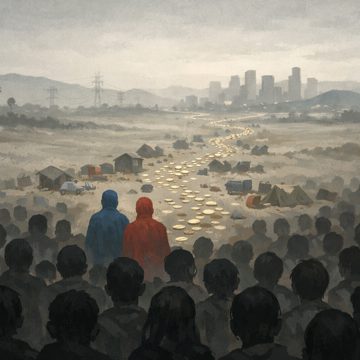
A set of debates on deportation, migration, racism, and foreign influence shows how immigration policy is tied to minerals, sovereignty, colonial history, and political polarization.

A controversial deportation deal has drawn attention to how migration policy can be tied to geopolitics and extraction. In one case, Latin American immigrants were sent to the Democratic Republic of the Congo under an arrangement that critics say traded human lives for strategic access to mineral resources. The decision was widely described as a form of outsourcing enforcement, where wealthy states shift the burden of migration control onto poorer countries with fewer resources and weaker infrastructure. The people deported in this kind of arrangement are often left in a severe legal and practical limbo, far from home and without the means to return. That reality has fueled accusations that the policy is not just harsh but deliberately humiliating, designed to discourage migration through suffering.
The larger debate goes beyond one country or one deal. Similar proposals and policies in other places have encouraged the idea that deportation can be exported to third countries, even when those countries are not the origin of the people being removed. Supporters present this as a pragmatic answer to irregular migration, but critics see it as a moral failure and a sign that powerful governments are willing to treat vulnerable people as bargaining chips. The discussion often returns to the same question: if a state cannot or will not process asylum and migration fairly at home, does sending people elsewhere solve anything, or does it only hide the cruelty behind a larger geopolitical transaction?
Immigration debates in Spain show a different but related tension. Some Latin American immigrants argue that they face excessive bureaucracy despite sharing language and cultural ties with Spain. They describe a system that seems to promise closeness and openness, yet still makes legal status difficult to secure. Others respond that Latin Americans actually have a relatively easier path to citizenship than many other nationalities, and that the two-year residency rule reflects a special relationship rather than exclusion. Even so, the conversation quickly becomes political, with accusations that one side wants migrants for votes and the other wants to shut the door entirely.
These arguments are not only about paperwork. They also reflect anxieties about jobs, public services, identity, and social change. Some participants blame migrants for pressure on housing and welfare systems, while others insist that the deeper issue is inequality and underinvestment. The result is a familiar split: one camp sees migration as a threat to cohesion, while another sees hostility to migrants as a cover for broader economic and class resentment. In that sense, the debate over Spain mirrors many other immigration fights across the West, where legal status, cultural belonging, and electoral strategy are all tangled together.
Mexico appears in several of the discussions as a place where sovereignty, intervention, and internal inequality collide. One thread focused on the death of two U.S. officials in a car accident during a counter-narcotics operation, which led to questions about foreign involvement and the limits of national control. Some commenters argued that the presence of outside actors is always politically sensitive, especially in a country with a long history of security crises and pressure from abroad. Others took a more cynical view, suggesting that foreign influence is already built into the system and that formal sovereignty often masks a much messier reality.
That same cynicism also shows up in conversations about racism in Mexico. Several comments describe racism there as deep, widespread, and often denied. The discussion distinguishes between colorism, xenophobia, and class prejudice, but many participants argue that these forms of discrimination overlap in daily life. Some say European features are still treated as a status symbol, while darker skin and indigenous identity remain stigmatized. Others point out that anti-foreigner sentiment can be intense even when it is dressed up as humor or nationalism. The common theme is denial: people often refuse to name racism directly, even when they experience or witness it constantly.
The thread also connects modern migration patterns to older colonial dynamics. A discussion about Costa Rica framed foreign investment, especially from North American newcomers, as a new version of settlement and displacement. Rising prices, private enclaves, and control over land and water were described as forms of soft colonization, where wealthier outsiders reshape local life without formal conquest. Critics of this view dismissed it as exaggeration or victimhood, but supporters argued that the pattern is real and familiar: capital arrives, local residents are priced out, and the culture of the place is transformed to serve outsiders.
That argument reflects a broader discomfort with how colonial history lives on in modern economics. Even when there is no empire in the old sense, the logic of extraction can remain. Land becomes an investment, housing becomes a commodity, and local communities are forced to adapt to outside demand. In this reading, gentrification is not just a real estate trend but a continuation of older structures of displacement. The language may be new, but the power imbalance looks very old.
Another debate in the thread turned toward political extremism and the way historical comparisons are used in online culture wars. An image contrasting Klan violence with modern progressive ideology sparked a fierce argument over whether the comparison was meaningful or absurd. Some defended it as a critique of dogmatism and moral certainty on the left. Others rejected it outright, saying it flattened the difference between a racist terror group and movements that broadly argue for equality and inclusion. The argument was less about one image than about the larger habit of treating the other side as inherently monstrous.
Taken together, the discussions show how migration and deportation cannot be separated from power. Whether the issue is a deportation deal tied to minerals, a citizenship system shaped by class and identity, foreign influence in security affairs, or the legacy of colonialism in housing and land, the same pattern appears again and again. People are not only arguing about borders. They are arguing about who gets to move, who gets to stay, who benefits from global inequality, and who is forced to pay the human cost.