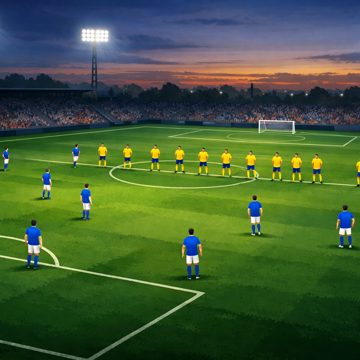
Tyler Adams is central to the USMNT's 2026 World Cup hopes as the team looks for stability, leadership and a midfield anchor on home soil. The challenge is not just talent, but whether the Americans can turn a promising core into a side ready for the biggest stage.
soccerleadership2026 World Cupfitnesstyler adamsUSMNTUnited Statesmidfield

Tyler Adams sits at the center of the United States men's national team conversation as the 2026 World Cup approaches. For a team that will play on home soil and carry far more expectation than in recent cycles, Adams represents something the USMNT has often lacked: a proven midfield organizer who can set the tone without needing the spotlight.
That matters because the Americans are entering the tournament with a mix of optimism and pressure. The talent pool is deeper than it was a few years ago, but the gap between potential and performance still hangs over the program. Adams is one of the players most closely tied to whether the USMNT can look like a serious contender rather than a team hoping to survive the group stage and catch form later.
The appeal of Adams is easy to understand. He brings defensive discipline, energy, and leadership in a role that rarely gets the headlines but often decides whether a team stays balanced under stress. In a World Cup, especially one staged in the United States, that kind of player can become indispensable. The Americans will need someone who can break up attacks, keep the shape intact, and steady the side when the game gets chaotic. Adams has built his reputation on doing exactly that.
There is also a symbolic layer to his importance. The 2026 tournament is being billed as a moment for soccer in the United States to reach a new level of visibility. Adams has spoken in broad terms about the chance to change how the sport is seen in the country, and that idea fits the moment. A successful USMNT run would not be about one player alone, but Adams is the kind of figure who can embody the team's identity: hard-working, tactically aware, and unafraid of responsibility.
Still, the road to 2026 is not just about ideals. The biggest question around Adams is whether he can stay available and effective through the full buildup. Fitness has been a recurring concern in recent years, and the USMNT cannot afford to build its structure around a player who is only partially ready. If he is healthy, he gives the team a cleaner midfield and a better platform for the more creative players ahead of him. If he is not, the team has to rethink its balance.
That is where the broader challenge for the USMNT comes into view. The squad has attacking talent and enough individual quality to compete, but tournament soccer punishes sides that are disorganized or emotionally fragile. Adams is valuable because he helps prevent both problems. He is not the player expected to score the decisive goal, but he may be one of the reasons the Americans are in position to create one.
The context around the 2026 World Cup only raises the stakes. With the event coming to North America, the USMNT will face enormous public attention, commercial pressure, and the simple expectation that the team should do better than in past cycles. There is no hiding behind the idea that the tournament is elsewhere. The Americans will be judged at home, in front of a crowd that wants proof the program has matured.
That makes Adams even more important as a stabilizing presence. Teams that overreach in a home World Cup often discover that excitement alone is not enough. They need structure, discipline, and players who can handle the emotional weight of the occasion. Adams has the profile for that role. He is not the flashiest name in the squad, but he may be among the most trusted.
The USMNT's path will also depend on how the rest of the roster develops around him. If the attacking players continue to grow and the defense becomes more reliable, Adams can do what he does best: connect the lines, close space, and make the team harder to play against. If the supporting cast is inconsistent, then he will be asked to cover too much ground and solve too many problems at once. That is a difficult burden even for a player of his quality.
Another reason Adams matters is that he gives the team a clear standard. International tournaments are often decided by small details, and standards help teams avoid the kind of lapses that end campaigns early. Adams plays with urgency and control, which can be contagious. Younger players benefit from that kind of example, especially in a squad that may include several players experiencing their first World Cup on home soil.
The 2026 tournament will not be won by sentiment, and it will not be won by reputation alone. The USMNT has to prove it can manage the basics at a high level before anyone talks seriously about a deep run. Adams is one of the players most associated with that baseline competence. He helps define what the Americans should look like when they are functioning properly: organized, aggressive, and difficult to break down.
For that reason, Tyler Adams is more than just another name in the USMNT pool. He is a measure of how far the team has come and how far it still has to go. If he arrives fit and in form, the United States gains a midfield anchor and a leader for its biggest test in decades. If he is absent or limited, the team loses one of the clearest links between raw ambition and actual tournament readiness.
That is why Tyler Adams remains central to any serious assessment of the USMNT's 2026 World Cup hopes. The Americans have talent, home-field advantage, and a rare chance to make a statement. But in the end, their ceiling may depend on whether Adams can help turn those advantages into something more durable: a team that knows who it is, trusts its structure, and can handle the pressure when the tournament begins.