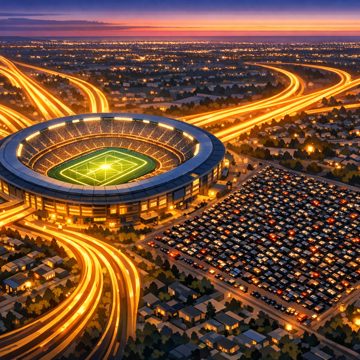
Mexico City is at the center of the 2026 World Cup story as the tournament returns to one of soccer's most storied capitals. The city faces a mix of excitement, transit pressure, stadium logistics, and a chance to turn global attention into a lasting legacy.
soccertransitlegacystadium logistics2026 World CupFIFA World Cup 2026Mexico Cityhost city

Mexico City is set to play a defining role in the 2026 World Cup, and the scale of that role goes far beyond a few matches. As one of the tournament's most recognizable host cities, the capital will be asked to deliver the kind of atmosphere that has long made it one of the sport's landmark destinations while also handling the practical demands of a giant international event.
That combination of spectacle and strain is what makes Mexico City such a central part of the World Cup conversation. The city brings history, size, and a deeply rooted soccer culture. It also brings the everyday realities that come with hosting thousands of traveling fans, team staff, media crews, and matchday workers in a metropolis already known for heavy traffic, dense neighborhoods, and complex transit patterns.
For many supporters, the appeal is obvious. Mexico City's place in World Cup history gives the tournament a sense of continuity that newer host venues cannot match. The city has long been associated with major international soccer moments, and its return to the global stage is likely to draw visitors who want more than a ticket to a game. They want the setting, the energy, and the sense that they are watching the tournament in one of its most iconic environments.
At the same time, the 2026 edition is not a simple rerun of past tournaments. The event has expanded to 48 teams and 104 matches across three countries, which means host cities must absorb a larger and more complicated flow of visitors than in previous World Cups. In a place like Mexico City, that raises immediate questions about transportation, crowd movement, public safety, accommodation, and how the city integrates matchday operations with normal urban life.
Transit is likely to be one of the biggest pressure points. Large tournament crowds tend to expose every weakness in a city's rail, road, and airport systems, and Mexico City is no exception. Getting fans to and from stadium areas efficiently will matter not just for comfort but for the reputation of the event itself. Delays, bottlenecks, and confusing access routes can quickly overshadow the football. A smooth experience, by contrast, can turn a difficult logistical challenge into a point of pride.
The stadium environment will also be under a microscope. World Cup host venues are expected to function not only as sports arenas but as highly controlled public spaces with security screening, arrival staging, transport links, and clear wayfinding. In a city as large as Mexico City, that means the areas around the stadium will likely become temporary hubs of activity, with local businesses, transit operators, and city services all pulled into the tournament footprint.
There is also the broader issue of what the World Cup leaves behind. Host cities often promise infrastructure improvements, better transit coordination, and renewed international visibility. Mexico City will face the same test. The challenge is not simply to host matches successfully, but to ensure that any upgrades or planning gains remain useful after the final whistle. If the tournament only creates short-term disruption, it will be remembered differently than if it helps improve mobility, public space, or city services in lasting ways.
That legacy question matters because Mexico City already carries a powerful soccer identity. The city does not need to invent passion for the sport; it needs to channel it. The best version of a home World Cup is one where local fans feel that the event belongs to them as much as to visiting supporters. That means accessible tickets, sensible transport, public viewing areas, and a matchday atmosphere that feels inclusive rather than sealed off for tourists and officials.
The emotional side of the tournament should not be underestimated. For many residents, the World Cup will be a rare moment when the city is seen around the world through a single lens. That can create pride, but it can also create pressure. Every delay, every crowd-control problem, and every service failure will be magnified. The city will be judged not just on the football played inside the stadium, but on how it manages the spaces around it.
Mexico City's role also matters because the 2026 tournament is being staged across North America, where host cities will be compared constantly. Some will be judged on efficiency, others on atmosphere, others on ease of access. Mexico City will likely be measured on all three. It has the advantage of deep football culture and the disadvantage of a huge urban footprint. That makes preparation crucial. The event will not reward improvisation.
Still, the city has one major asset that cannot be built from scratch: identity. In a World Cup that spans three countries and a wide range of venues, Mexico City stands out as a place where the tournament can feel rooted in history rather than assembled purely for television. That gives it a chance to shape the tone of the event, not just host a portion of it.
The next year of preparation will determine whether Mexico City becomes one of the defining stories of the 2026 World Cup. If the city can manage transport, security, and crowd flow while preserving the atmosphere that makes it special, it will offer a model for how a massive urban center can host global football without losing its character. If not, the scale of the event could overwhelm the experience.
Either way, Mexico City is central to the tournament's identity. It is not just another stop on the schedule. It is one of the places where the 2026 World Cup will be tested, remembered, and judged.