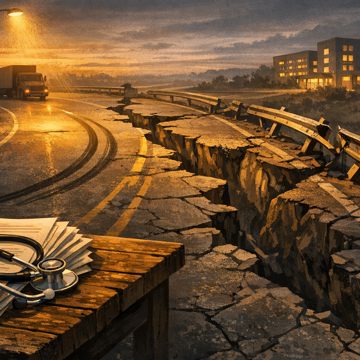
From flood maps and hazard mitigation plans to emergency systems training and product safety reviews, FEMA appears in debates about housing, local government planning, fire service careers, and regulatory standards.

FEMA shows up in a wide range of public policy and practical planning decisions, from flood risk and housing to emergency response systems and local government eligibility for grants. In one example, a city council agenda included adoption of a multi-jurisdictional hazard mitigation plan, a move tied directly to maintaining eligibility for FEMA grants. In another, homebuyers were urged to check flood maps before deciding whether a slab foundation made sense in a low-lying neighborhood.
The housing question is especially important in places built on reclaimed or drained land. In older neighborhoods, elevated homes on piles or raised foundations are common because the ground and water conditions demanded it. But after large-scale drainage projects and levee improvements, newer development expanded into areas that had previously been considered unsuitable for conventional building. That shift, combined with postwar housing demand and modern building methods, led to many slab homes in areas where moisture, subsidence, and flood history remain major concerns.
A slab foundation is not automatically a problem, but it changes the risk profile. Without a crawl space, moisture issues can be harder to see and flood damage can be more complicated to assess. Buyers are often advised to look beyond a simple flood zone label and examine elevation certificates, insurance costs, and the specific history of the property. Flood maps are useful, but they are only one reference point. They do not tell the whole story about how a home will respond when water rises or the ground shifts over time.
That distinction matters because local conditions can vary sharply even within the same flood zone. Two homes on the same block may have very different insurance premiums and very different exposure to risk. In some areas, homeowners also deal with subsidence, where the ground under a slab slowly sinks or shifts. In those cases, sand pumping may be used periodically to slow the process, adding another cost for property owners to consider.
FEMA also appears in the world of public safety training and emergency management. One person working through EMT and FEMA certifications asked whether a fire department could support additional counselor training as part of a broader career path. The answer pointed to a difficult reality: departments often need paramedics, firefighters, and people with strong operational credentials first, while mental health support is usually handled through employee assistance programs or outside specialists. Still, there is a recognized need for counselors who understand emergency service work and the pressures that come with it.
That same emergency management framework extends into incident command systems and disaster response training. People who work with FEMA courses often encounter NIMS and ICS, the standardized systems used to organize large-scale response operations. Those systems can be useful not only in disaster work but also in structured role-playing or training environments where coordination, chain of command, and clear responsibilities matter. The appeal is obvious: when a crisis unfolds, the more predictable the structure, the easier it is to keep order.
FEMA's influence is also visible in local governance. A city council packet listed a hazard mitigation plan nearly 1,000 pages long, with the explicit note that adoption would preserve eligibility for FEMA grants. That kind of planning is often unglamorous, but it shapes how communities prepare for storms, flooding, infrastructure failures, and other emergencies. It also affects which projects get funded and which risks are prioritized.
In some areas, FEMA-related planning intersects with heated questions about development, annexation, and infrastructure costs. Municipal planners may approve expansions into new districts while also asking who will pay for roads, drainage, utilities, and long-term service needs. Those questions are not abstract. They determine whether growth is sustainable or simply pushed into places that will later require expensive fixes.
FEMA also enters the conversation through product safety and regulation. One recent analysis of nicotine pouches argued that child-resistant packaging is important but not enough on its own. The broader point was that product safety depends on the toxicological suitability of ingredients, the quality of the manufacturing process, and the design of the final product as a whole. Packaging can reduce accidental exposure, especially for children, but it does not substitute for ingredient review and risk assessment.
That argument reflects a larger trend toward more detailed regulatory scrutiny. In premarket tobacco product applications, product-specific rules for nicotine pouches remain limited, so regulators focus on nicotine delivery, harmful constituents, and leachables from materials. But as applications become more detailed and review systems more automated, superficial submissions are increasingly likely to be rejected early. That puts pressure on manufacturers to provide meaningful scientific substance from the start rather than relying on minimal filings.
The larger lesson across these examples is that FEMA is not just a disaster agency in the narrow sense. It is part of a broader system that shapes how communities build, how they prepare, how they regulate risk, and how they recover. Whether the issue is a home on a slab, a city seeking grant eligibility, a firefighter candidate trying to map out a career, or a regulated product that needs a credible safety case, the same basic principle applies: risk has to be understood early, not after the damage is done.
That is why FEMA-related decisions often feel technical but have very real consequences. Flood maps affect insurance and home values. Hazard mitigation plans affect funding. Emergency management systems affect how responders coordinate under pressure. And in each case, the details matter. A label, a map, or a form is not enough on its own. The real work is in the underlying planning, evidence, and judgment that make those tools useful in the first place.