El Clasico is back at the center of football talk, with Real Madrid dealing with a reported training-ground clash, fresh reflections on the Messi-Ronaldo era, and Harry Kane's record scoring pace adding to a season defined by star power and pressure.
barcelonamessiReal Madridel clasicovalverdetchouamenironaldoharry kanelaliga

El Clasico is once again carrying more than the weight of three points. The fixture between Real Madrid and Barcelona has become the backdrop for a wider story about pressure, identity, and the way football's biggest names still shape the sport. This time, the build-up has been colored by reports of tension inside the Real Madrid camp, reminders of the Messi-Ronaldo rivalry that defined a generation, and the sense that modern stars are still chasing the standard set by the game's most relentless finishers, including Harry Kane's record-level scoring form.
At Real Madrid, the most eye-catching detail has been the suggestion of a training-ground clash between Federico Valverde and Aurelien Tchouameni. Even when treated with caution, the episode fits a familiar pattern at elite clubs before El Clasico: every sharp challenge, every heated exchange, every selection decision gets magnified. Real Madrid have often thrived on intensity, but when the pressure rises, that same edge can spill over. The club's response has reportedly been to treat the matter as a disciplinary issue rather than a full-blown crisis, with fines seen as the preferred route and no suspension expected to keep Tchouameni available against Barcelona.
That matters because El Clasico rarely arrives in a calm atmosphere. It is a match that exposes every weakness and rewards every ounce of conviction. If Real Madrid are carrying internal friction into the game, Barcelona will see an opportunity to test that resolve early. The emotional temperature around this fixture has always been part of the spectacle. What makes it different from a normal rivalry is that the stakes are never just local. The result can reshape a title race, alter a season's narrative, and change how both clubs are judged for months.
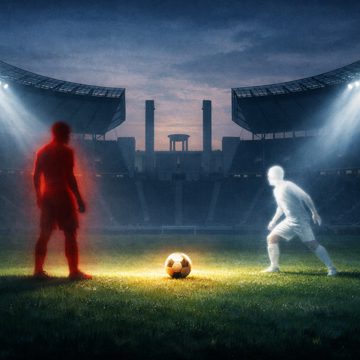
The timing also invites comparison with the era when Messi and Ronaldo made El Clasico feel like the center of the football world. Messi's recent reflections on Ronaldo underline how unusual that period was. He described the rivalry as pure sport, built on mutual respect rather than personal hostility, and said the two were usually only crossing paths at matches or award ceremonies. That tone is important because it captures what made the rivalry so compelling: the competition was fierce, but it was also clean, almost elegant in its simplicity. Barcelona and Real Madrid were fighting for everything, and their two defining players were fighting for everything as well.
For many supporters, that era still serves as the benchmark for what El Clasico can be. It was not only about goals or trophies. It was about the feeling that every meeting could produce a new answer to the same question: who would rise higher this time? One match could end in a Messi brace, the next in a Ronaldo hat trick, and the cycle would continue until the sport itself seemed to revolve around those two names. The rivalry gave the fixture a gravitational pull that is still hard to replace.
That is why current El Clasico conversations often circle back to aura. Some of the most common reactions to the Messi-Ronaldo reflections are not about statistics at all, but about the sense that football no longer looks or feels the same without them. The modern game still has elite talent, but the combination of longevity, consistency, and direct head-to-head drama is rare. The emotional memory attached to those meetings remains unusually strong, especially for the years when Barcelona and Real Madrid were not just playing big matches, but playing the biggest matches in the sport.
The contrast with today's stars is part of the story too. Harry Kane's name has entered the wider conversation because his scoring pace has been so relentless that it invites comparison with all-time standards. Kane represents a different kind of excellence: less theatrical than the old Clasico icons, but brutally efficient and historically productive. In a season where records are still being chased and redefined, his form is another reminder that football continues to produce players capable of stretching what seems possible. Yet even that level of output exists in the shadow of the Messi-Ronaldo benchmark, which still defines how greatness is measured.
For El Clasico itself, this is the challenge and the opportunity. The fixture does not need to recreate the past to matter, but it does need a narrative strong enough to carry its own weight. A Real Madrid squad dealing with internal tension, a Barcelona side looking for advantage, and a broader football landscape still shaped by memories of two giants all help provide that frame. The game remains more than a derby. It is a cultural event, a sporting pressure test, and a stage where reputations are built or damaged in ninety minutes.
There is also the practical question of how Real Madrid channel the emotion. Teams can come apart when a training-ground dispute becomes a distraction, but they can also sharpen into something more dangerous. If the fines and warnings are enough to settle the matter, the incident may fade quickly. If not, Barcelona will sense vulnerability. That is the fine line around El Clasico: the same intensity that fuels greatness can also create the cracks an opponent can exploit.
What has not changed is the scale of expectation. Supporters still approach the match as if it might produce a defining moment, because so often it has. Whether the storyline is a locker-room dispute, a title race, or the echo of the Messi-Ronaldo years, El Clasico keeps absorbing whatever football throws at it. That is why it remains central to the sport's calendar and to its imagination. The names change, the setting changes, and the context changes, but the demand stays the same: deliver something unforgettable.
And that is what makes this version of El Clasico especially compelling. It is not only about who wins on the pitch. It is about how Real Madrid respond to pressure, how Barcelona read the moment, and how the game continues to live in the long shadow of Messi, Ronaldo, and the extraordinary standard they set. Even as new stars like Kane keep rewriting scoring records, El Clasico remains the stage where football's biggest questions still feel largest.