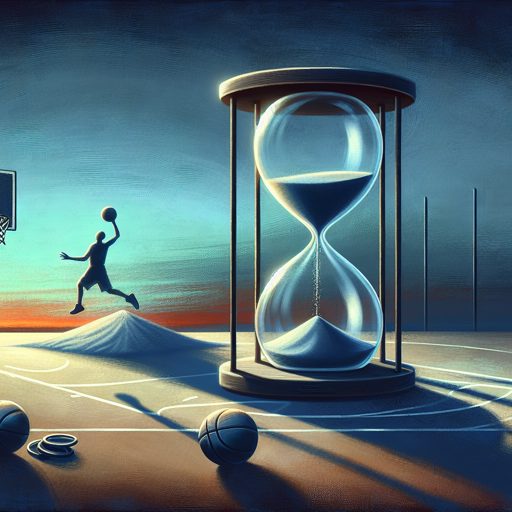
A set of sports hypotheticals tests how far an average person could get against peak versions of elite champions with infinite retries. The exercise highlights how different sports reward raw skill, strategy, endurance, and split-second timing.
james woodsports hypotheticalsgoattime looplebron jamesmagnus carlsenfakertiger woodsnovak djokovicmuhammad ali
A thought experiment built around James Wood asks a simple but revealing question: if an average person could retry forever, which all-time great would still be the hardest to beat in a one-on-one contest? The setup is strict. The human keeps every memory from each loss, but the opponent stays in peak condition and never learns from previous loops. There is no shortcut, no way to break the cycle by force, and the only way out is to win legally under the rules of the sport.
The list covers basketball, chess, League of Legends, golf, tennis, and boxing. Each matchup uses a different win condition, from first to 12 points to best-of-five sets to checkmate or draw. The premise is less about fantasy and more about measuring how much of greatness comes from repeatable skill versus rare physical or mental dominance.
On paper, the easiest target is Faker in League of Legends. That is not because he is weak, but because the game format is the least pure 1v1 test on the list. Even in a mirror-match setting on Howling Abyss, the average player can improve with each loop, learn spacing, and eventually force a narrow first blood or 100 CS win. The argument is that the win condition is low enough that enough repetitions should eventually produce a result, even against a legend.
Chess sits at the opposite end of the spectrum. Magnus Carlsen in classical chess remains the most intimidating kind of opponent because the game is entirely about information, calculation, and long-term precision. A human with infinite retries can learn openings and patterns, but each game still demands avoiding a single fatal mistake against someone operating at the highest level. Unlike a reflex-based contest, there is no cheap rush strategy. The best hope is that memory eventually closes the gap, but the road to a legal win is still brutal.
Tennis against Novak Djokovic adds another layer: endurance, serve quality, return skill, and mental pressure. Best-of-five sets gives the human more room for adaptation, but it also means more chances for the champion to exploit any weakness. A time loop helps with anticipation and tactical learning, yet the opponent remains one of the most complete athletes ever to play the sport. Beating him once under full rules would require not just improvement, but enough consistency to survive a long match against a player who rarely gives away free points.
Tiger Woods in golf presents a different kind of challenge. Golf is not a direct duel in the same way as boxing or tennis, but it still becomes a brutal comparison when the goal is to post a lower score over nine holes. The advantage of repeated loops is obvious here: the player can memorize course layout, shot shape, and risk-reward decisions. Still, the margin for error against a prime Tiger is tiny. One bad drive, one missed putt, or one poor recovery can erase a dozen good loops of progress.
Basketball against LeBron James is a strange middle ground. The scorer gets the ball, and the first to 12 points wins. That means the human has a chance to grind out a few lucky possessions, especially with memory of what LeBron is likely to do. But LeBron in peak form is a force of size, speed, and decision-making that is hard to outlast in a short game. The average person may be able to steal a point or two, yet winning to 12 still demands both offense and defense against one of the most complete players ever.
Muhammad Ali in boxing may be the most punishing test of all. Twelve rounds, regular rules, and a prime Ali create a nightmare for anyone without elite athleticism. The time loop offers a path through learning, but boxing is unforgiving because every round is a physical trial. The average human can improve timing and defense, but Ali's speed, footwork, and ability to control distance make it hard to even survive long enough to build a winning strategy. Unlike chess, boxing does not reward endless slow improvement as cleanly; every mistake has immediate consequences.
What makes the ranking interesting is that it is not just a list of the greatest athletes. It is a list of the hardest ways to beat them under a very specific loophole: infinite attempts, but no memory carryover for the opponent. That changes the meaning of greatness. In chess, memory and study matter enormously. In boxing and tennis, physical limits remain dominant. In basketball, a short score target creates some randomness. In League of Legends, the structure itself gives the average player a path that does not exist in the other matchups.
The most important conclusion is that not all greatness is equally vulnerable to repetition. Some contests can be solved by learning patterns over time. Others remain nearly impossible because the opponent's prime condition is enough to overwhelm even a smarter, more experienced challenger. If the goal is to rank the hardest sport to beat against its respective goat, the answer is less about the name on the list and more about how the sport itself distributes advantage.
That is why the debate keeps circling back to the same core question: does infinite time beat elite talent, or does elite talent still win because the sport leaves too little room for error? In some cases, the loop turns defeat into eventual progress. In others, it only turns defeat into a longer punishment. James Wood's scenario makes that tension the whole point.